
The leadership and talent landscape continues to evolve in response to shifting organisational, economic and cultural dynamics. Insights from leading institutions and member firms help frame the current conversation, from the future of work and CEO readiness to retention systems and career transitions. Below, we share a curated selection of perspectives that offer valuable guidance for boards, HR leaders and executive search professionals navigating an increasingly complex environment.
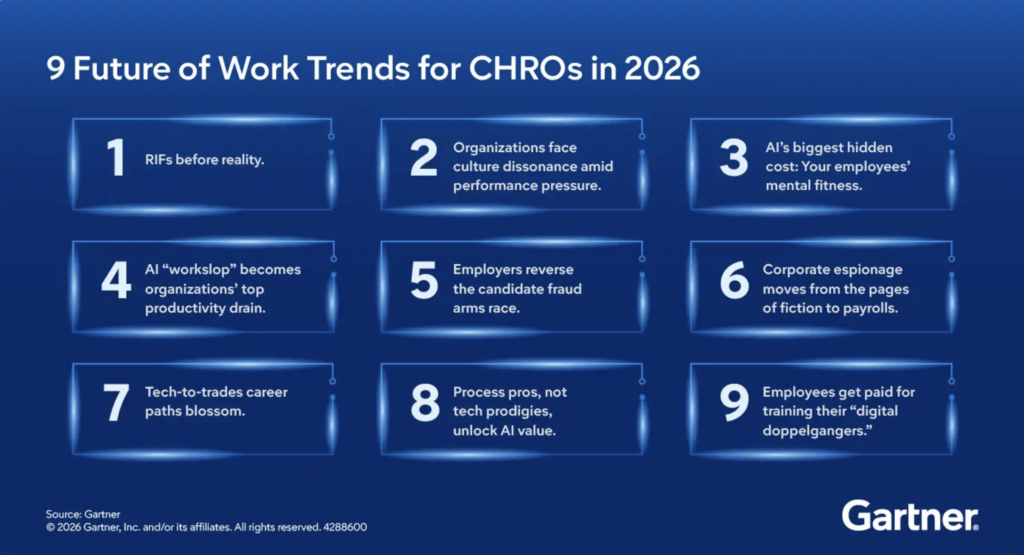
Gartner – CHRO Guide: 9 Future of Work Trends for 2026
In this article, Gartner highlights a clear shift in how organisations should think about transformation. The future of work will be shaped less by technology alone and more by how companies redesign work, culture and leadership around it.
The report points to increasing pressure on organisations to deliver AI-driven productivity before tangible value is fully realised. At the same time, performance expectations are rising faster than organisational cultures are evolving, creating new forms of internal tension. Gartner also signals emerging risks linked to AI adoption, from declining work quality to growing mental strain. Alongside these shifts, hiring priorities are changing, with greater emphasis on judgement, process expertise and leadership maturity rather than purely technical skills.
A central theme throughout the guide is the expanding strategic role of the CHRO, now positioned at the intersection of technology, culture and long-term workforce design.
KMR Executive Search: Why Career Pivots Stall

In this thought-provoking article, Ken McGovern, President of KMR Executive Search. explores why career transitions often struggle despite strong experience and proven capability. The central argument is clear: career pivots rarely fail because of a lack of talent; they fail when the narrative behind the move does not feel credible to decision-makers.
Hiring decisions are fundamentally about risk. When a candidate’s past experience does not clearly connect to current organisational needs, uncertainty tends to dominate. In that space, comparisons often emerge, sometimes against an idealised “perfect profile”, making it harder for unconventional backgrounds to gain traction.
Successful career changers, McGovern argues, do not attempt to mirror an ideal candidate. Instead, they replace comparison with clarity. By articulating a coherent and intentional professional narrative, they make trade-offs appear strategic rather than risky.
For hiring leaders and executive search professionals, the insight is equally relevant: clarity of story can significantly influence how potential and experience are assessed.
Harvard Business Review: Why Policies Alone Don’t Retain Top Talent
A recent article in Harvard Business Review highlights a timely and important insight: retaining top talent is rarely a matter of adding more HR policies , it is fundamentally a systems issue. Many organisations invest significant effort in individual initiatives such as engagement programmes, benefits updates or leadership workshops, yet retention challenges persist. The problem is not necessarily that these policies are ineffective, but that they often operate in isolation rather than as part of an integrated system.
The article argues that sustainable retention depends on how well organisations align and connect their core processes. Hiring, development and career progression need to reinforce one another. Leadership behaviours must embody the culture the organisation seeks to promote. Performance management, rewards and internal mobility should be aligned with long-term growth rather than short-term metrics.
When these elements fail to work together, even well-designed initiatives lose impact. For senior leaders and HR professionals, the message is clear: meaningful retention stems from coherent organisational design, not from layering additional standalone programmes.